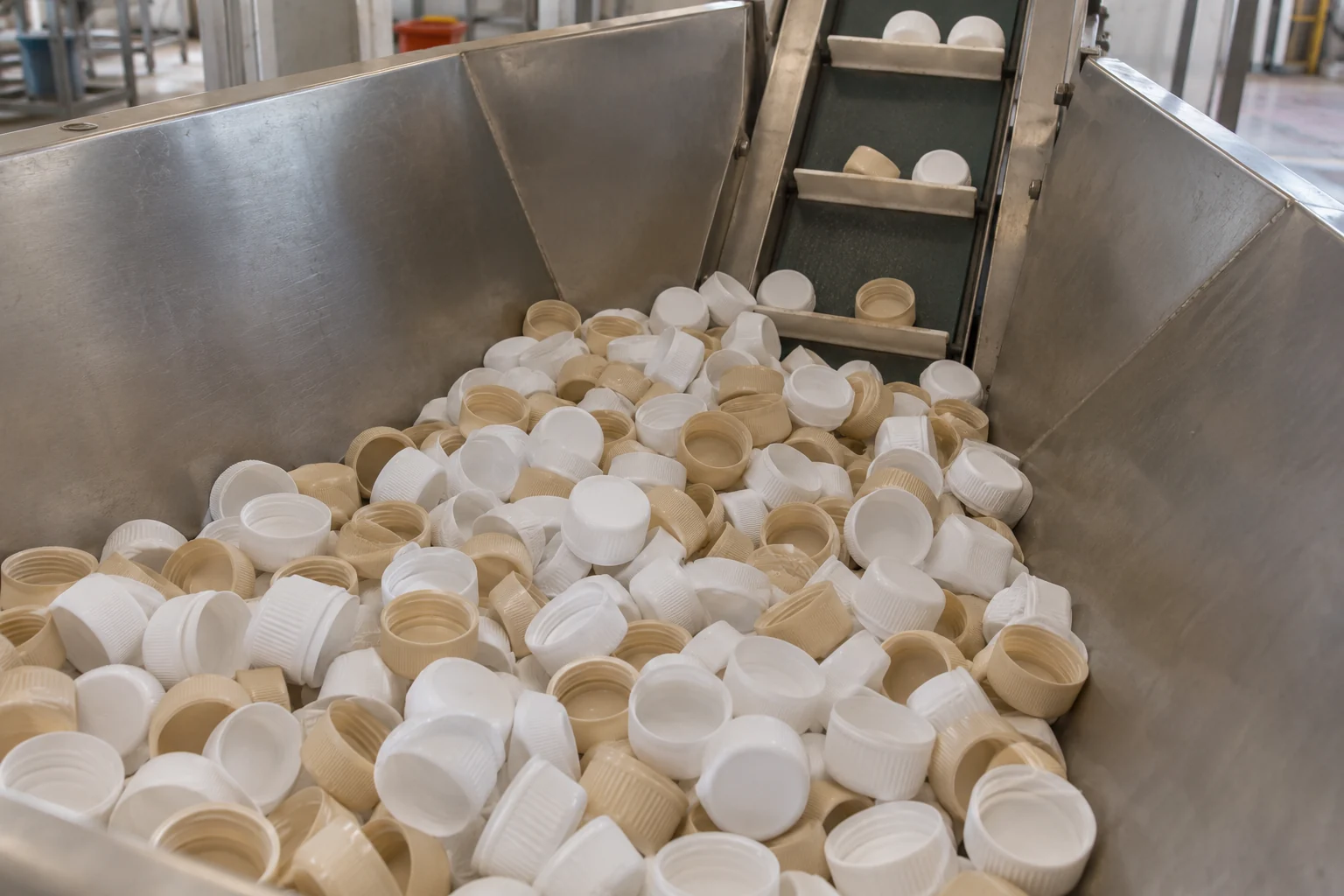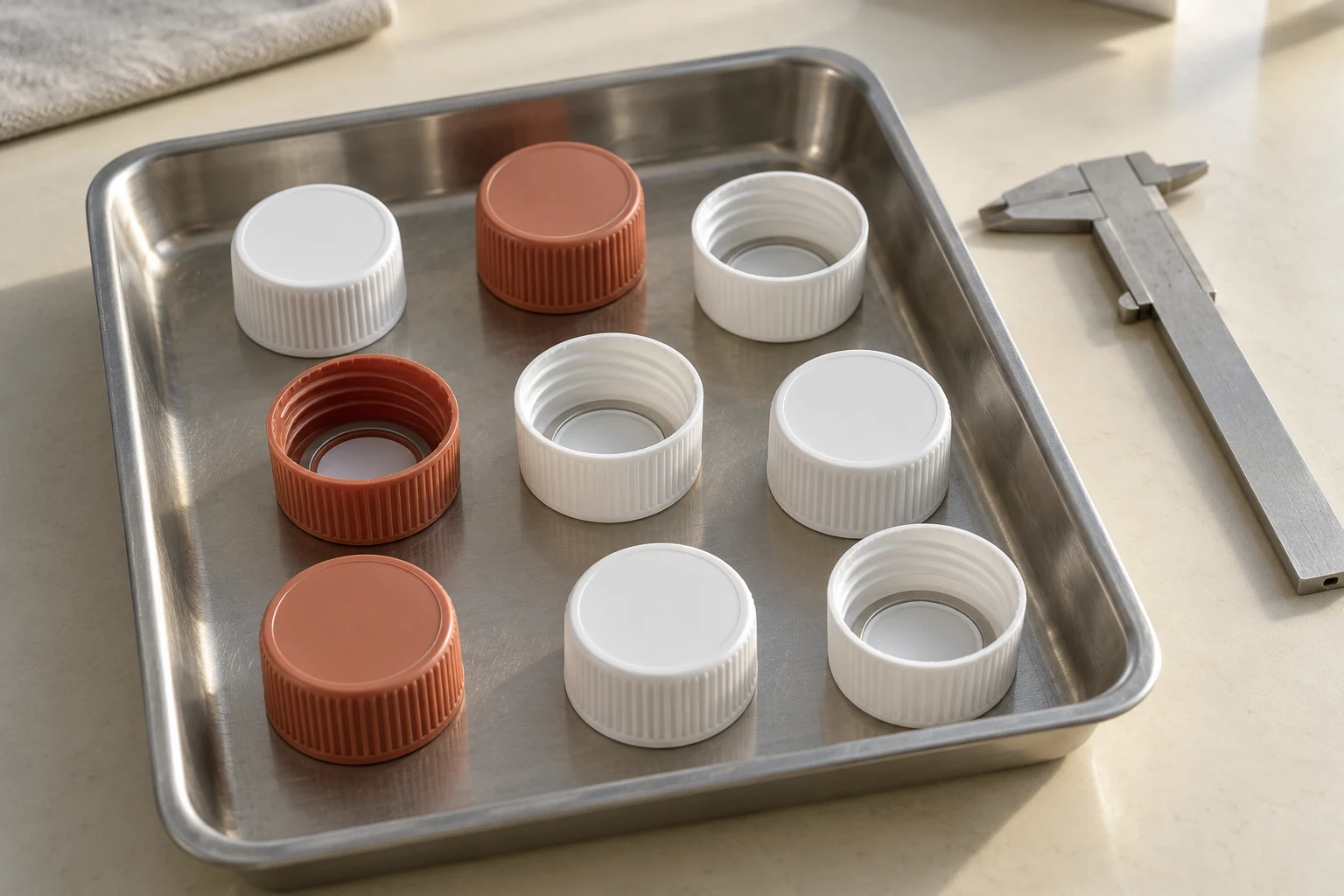
A disc top cap that arrives skirt-up, or a chuck that loads the movable disc, rejects bottles that are already filled. Match the finish code and the orifice, then prove the feeder and the grip on that cap.
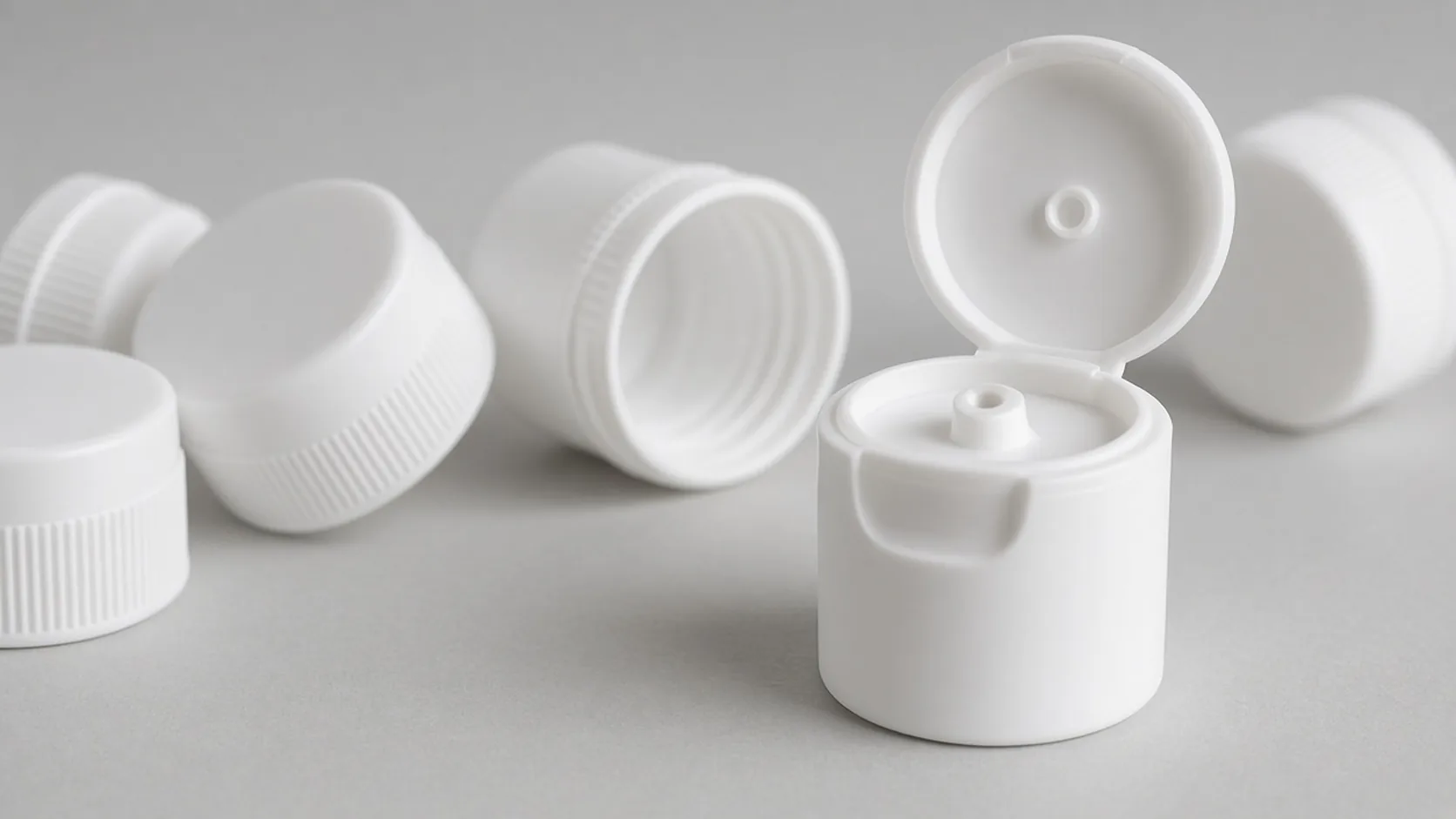
A disc top cap is a threaded closure with a hinged disc that opens for dispensing. Aptar’s Classic Cylindrical Disc Top family lists neck finishes 20-410, 24-410, 24-415 and 28-410, with seal types crab claw or plug and a menu of orifice sizes. Those listings are not one part. A 24-410 Flat Gloss disc top is published at 4.2 mm or 7.8 mm orifice with a crab claw seal. A 20-410 smooth-wall disc top is published at 6.6 mm with a crab claw seal. ULINE’s S-24591 is a separate 24/410 polypropylene disc top with a 1 1/8 inch outside diameter and a 3 mm opening. The public pages do not print a snap interference between the disc and the base. That dimension stays on the closure drawing.
Keep the finish code attached to the orifice
The first number in 24-410 is not a license to use every 24 mm disc top. Aptar lists 24-410 and 24-415 as separate neck finishes inside the same disc-top family, with their own orifice and seal rows.
| Published item | What the page states | Why it matters |
|---|---|---|
| Aptar 24-410 Flat Gloss Disc Top | Orifice 4.2 mm or 7.8 mm; crab claw seal | Two flow areas on one finish |
| Aptar 24-410 Frost Disc Top | Orifice 7.8 mm; plug seal | Same finish, different seal from the crab-claw rows |
| Aptar 24-415 Flat Smooth Wall Disc Top | Orifice 11.1 mm or 6.1 mm; plug seal | A 24-415 part is not the 24-410 part |
| Aptar 20-410 Smooth Wall Disc Top | Orifice 6.6 mm; crab claw seal | The 20-410 row is its own finish |
| ULINE S-24591 | 24/410, polypropylene, diameter 1 1/8 inch, opening 3 mm, 150 per case | Outside size and opening differ from the Aptar rows |
| Zalkin waterfall elevator | Up to 800 cpm (48,000 cph); round caps whose diameter is greater than their height; cleated belts and gravity | A speed ceiling and a shape rule |
| Zalkin CA 12 rotary | Up to 416 cpm (25,000 cph); diameter greater than height; no electronic sensors and no compressed air on that model | A lower ceiling than the waterfall |
Calculate the orifice area before calling two caps the same
Open area depends on the diameter printed for that row.
A = π × d² / 4
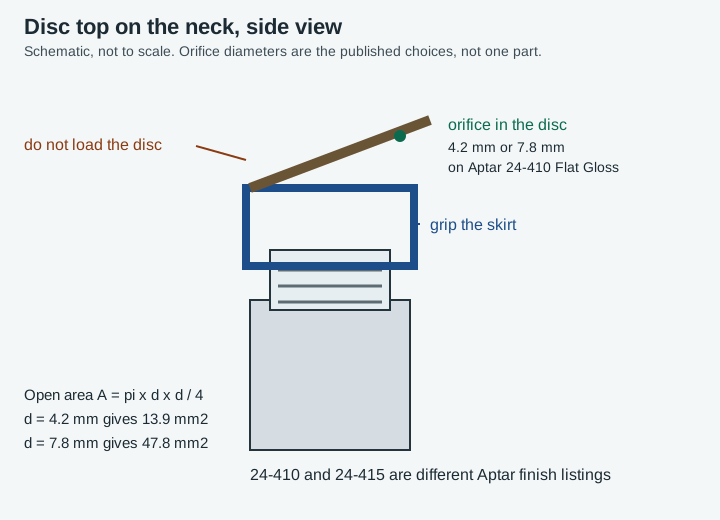
For the Aptar 24-410 Flat Gloss pair, d = 4.2 mm gives A = 3.1416 × 17.64 / 4 = 13.9 mm². d = 7.8 mm gives A = 3.1416 × 60.84 / 4 = 47.8 mm². The ratio is 47.8 / 13.9 = 3.4. The larger published orifice has about 3.4 times the open area of the smaller one. That is geometry. It is not a measured flow rate. Viscosity and the length of the orifice still sit between area and dispensed volume.
ULINE prints a 3 mm opening on S-24591. A = 3.1416 × 9 / 4 = 7.1 mm². The Aptar 4.2 mm orifice has 13.9 / 7.1 = 2.0 times that area. A 24/410 mark on both catalogs does not make the openings interchangeable.
The outside diameter on S-24591 is 1 1/8 inch. 1.125 × 25.4 = 28.6 mm. Aptar’s page retrieved on 20 October 2026 does not print an outside diameter for the 24-410 Flat Gloss, so 28.6 mm cannot be assigned to that Aptar row.
Rules of thumb
If the closed cap’s diameter is not greater than its height, the Zalkin waterfall and CA 12 statements do not cover it. Both pages limit those orienters to caps whose diameter is greater than their height.
If two disc tops share “24” and differ in the finish suffix, keep them apart. Aptar’s 24-410 Flat Gloss and 24-415 Flat Smooth Wall rows list different orifices and, on the 24-415 smooth-wall row, a plug seal rather than the crab claw used on the 24-410 Flat Gloss.
If the chuck or spindle wheel bears on the movable disc, it is on the wrong surface. The capping guide says to apply the threaded skirt and not to use the movable top as the gripping surface.
A diameter test does not aim the orifice
Zalkin describes the waterfall as inclined cleated belts using the center of gravity, then a single-file chute. U.S. Bottlers describes the same elevator idea: caps that are not in the wanted pose fall off the flights by gravity, and a waterfall is the best fit for symmetrical, flat, round caps. Belt width on that sorter is published as 8 to 36 inches, chosen for speed. Correctly oriented caps are blown by air into the chute. None of those sentences state a clock position for an off-center orifice or a finger recess.
A disc top can pass a skirt-down test and still arrive with the orifice pointing anywhere around the axis. If the label, the chuck pocket or a later actuator needs that angle, the D > H rule has not supplied it. The CA 12 description orients caps leaving a rotating hopper without electronic sensors and without compressed air. It still states the diameter-greater-than-height condition, and it does not publish an orifice angle.
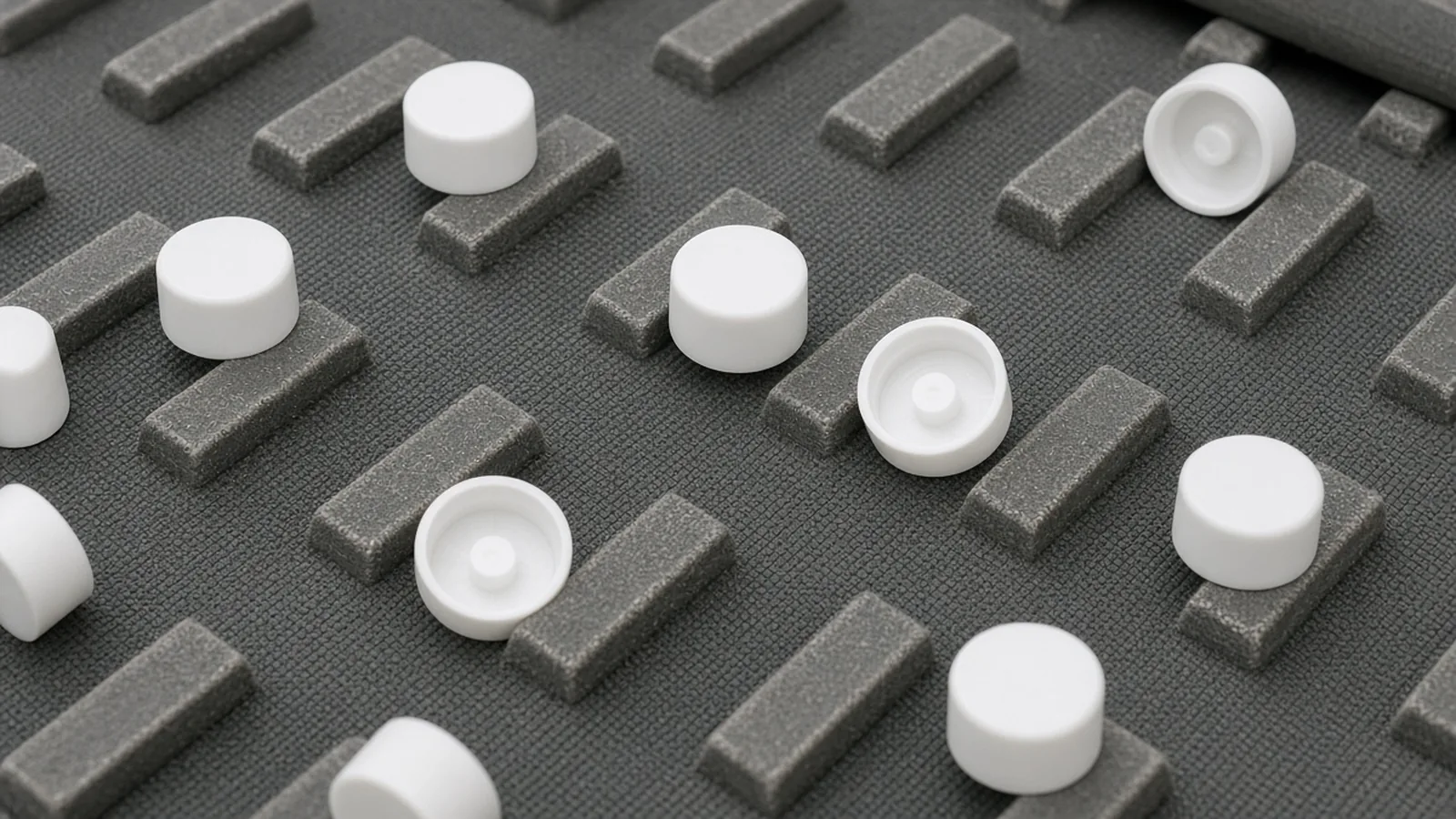
Grip the skirt and leave the disc free
The capping guide’s direct instruction is to apply the threaded skirt without using the movable top as a gripping surface, and to protect the hinge, lid and decorated surface. After capping, the disc still has to open and close. A head that closes the disc, ovalizes the orifice or marks the finger recess has failed even if the thread torque looks normal.
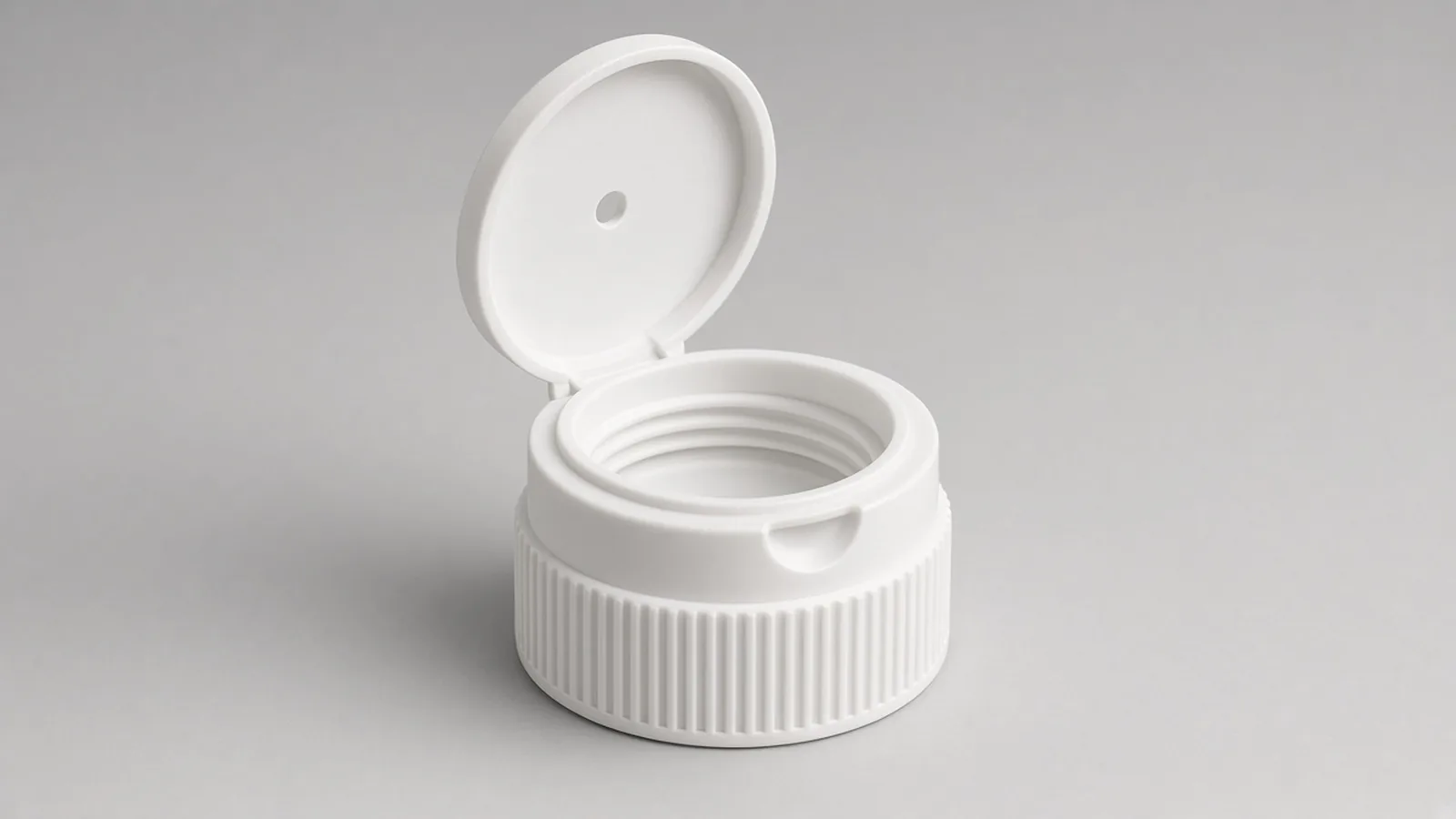
Compare the failures that stop a disc-top line
| Arrangement | What it is built to do | Dominant failure mode and prevention |
|---|---|---|
| Zalkin waterfall, up to 800 cpm | Face-orient round caps with diameter greater than height, by cleats and gravity | A disc top whose closed height exceeds its diameter, or an open disc that moves the center of gravity. Prevention: measure the closed cap and apply D > H before selecting this elevator. |
| Zalkin CA 12, up to 416 cpm | Rotary orientation without sensors or compressed air, same D > H limit | A line rate above 416 cpm is outside that model's published ceiling. Prevention: compare the required caps per minute with 416 before assigning this orienter. |
| U.S. Bottlers waterfall | Best fit stated for symmetrical, flat, round caps; misoriented caps fall off | A finger recess or an off-center orifice makes the cap less symmetrical than that statement. Prevention: treat skirt-down as only the first axis, and add a clocking check if the orifice angle matters. |
| Chuck on the disc | Would load the actuator instead of the skirt | The disc closes, cracks or will not reopen. Prevention: grip the threaded skirt, as the capping guide states, and confirm the disc still opens after application. |
Count the caps a wrong pose sends into the chuck
Rejected caps per hour = rate in caps per minute × 60 × assumed bad fraction
Take a planning rate of 500 caps per minute, which sits under the waterfall ceiling of 800 cpm and over the CA 12 ceiling of 416 cpm. In one hour that rate is 500 × 60 = 30,000 caps. If 1 percent leave the sorter skirt-up, the count is 0.01 × 30,000 = 300 caps per hour. The 1 percent is a planning assumption, not a measured sorter yield. U.S. Bottlers says the unwanted pose should fall back into the hopper. If a disc changes the center of gravity so those caps ride up instead, the 300 caps reach the chute. The loss is a stopped or damaged head, not a change in the 800 cpm nameplate.
The cap feeding guide separates bulk loading from orientation and from the handoff. The capping-machine guide is the next check after a cap is on the bottle. Finish identity for the neck itself is in the neck-finish guide. Return to cap feeding and capping for the line that has to do all three.
When this does not apply
A plain continuous-thread cap with no hinged disc does not need the skirt-versus-disc grip split or the orifice-area comparison. A pump or a trigger sprayer on a 24-410 neck is a different closure even when the finish code matches. Use this page for a disc top whose disc is the actuator.
Method and sources
Orifice diameters, seal types and neck finishes come from Aptar’s Classic Cylindrical Disc Top page. The 1 1/8 inch diameter, 3 mm opening and polypropylene note come from ULINE S-24591. Sorter ceilings and the diameter-greater-than-height rule come from Zalkin’s cap-orienting page. The symmetrical-cap and gravity-reject description comes from U.S. Bottlers. The skirt-grip instruction comes from the Capping Machines UK disc-top note. Areas, the inch-to-millimetre conversion and the 300-cap example are arithmetic on those figures or on the stated 500 cpm and 1 percent assumption. Photographs are illustrative. Retrieved 20 October 2026.