A closure drawing can stay unchanged while the customer’s bottle specification moves to a different revision. Link the bottle and cap drawings in the production release record, and treat an unresolved interface change as a reason to hold approval.
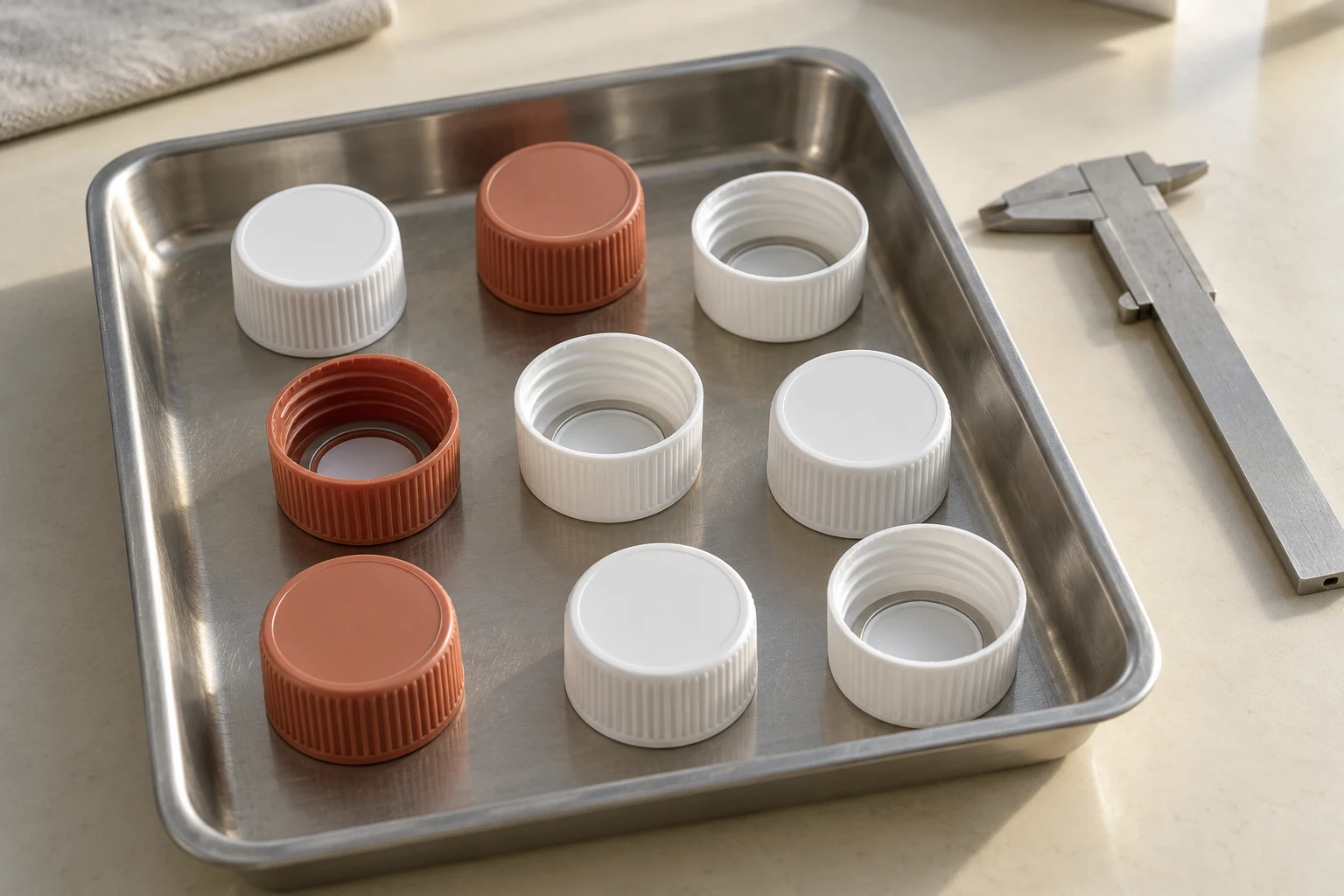
Keep a controlled mating pair
Obtain the actual bottle-finish drawing from the customer or its approved bottle supplier. Record the drawing number, revision and date beside the closure drawing. A nominal diameter or a photograph of a bottle is not enough to release a new tool or accept an unreviewed substitution.
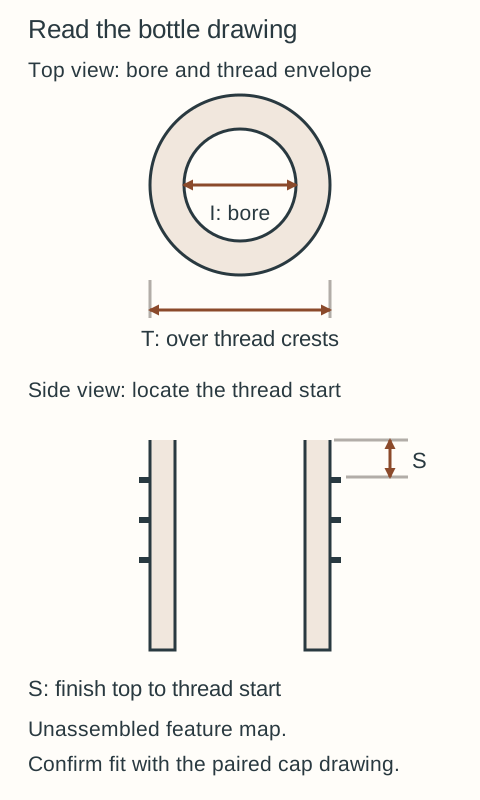
TricorBraun’s public explanation distinguishes the major outside thread diameter T, the neck bore I and the thread-start distance S. Those definitions help interpret a finish, but the customer’s controlled drawing supplies the tolerances and full geometry for the job. Confirm any difference in symbol definitions with the supplier.
Convert the interface into a measurement plan
Ask which closure features need dimensional inspection and which require assembled-package checks. Identify the datum, instrument or gauge, conditioning and acceptance reference for each feature. Do not use a cap that happens to screw on as a substitute for a controlled gauge or approved method.
| Release record | What the producer should retain | What it prevents |
|---|---|---|
| Bottle drawing | Number, revision, source and approval date | Testing against an obsolete interface |
| Closure drawing | Number, revision and sealing-feature definition | An uncontrolled cap substitution |
| Measurement method | Feature, datum, instrument and conditioning | Comparing unlike dimensional results |
| Sample identity | Lot, cavity where traceable and retention location | Losing the link between tooling and results |
| Package approval | Drawing pair, application setup and functional methods | Treating a dimension-only check as package approval |
For a liner or plug seal, have the relevant supplier identify the mating surface and approved conditions. Record any insert or liner reference as part of the cap specification. The thread holds the closure in position; do not assume its engagement alone establishes the intended seal.
Keep development and production samples separate
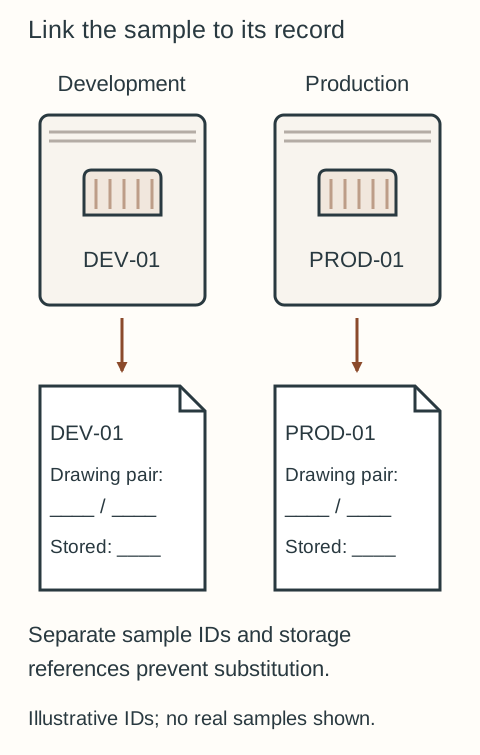
Label trial samples with their selection history and manufacturing condition. A development sample from one cavity should not quietly become the master for an entire production run. Agree the scope of cavity and lot checks with the customer, then retain enough identity information to investigate an outlying group.
Track a physical retained sample to the corresponding dimensional record. Protect the reference from damage and note when it is replaced. If the customer sends a new bottle, ask whether it represents a drawing change, a different lot or simply a repeat sample. Those distinctions determine the review needed.
Blank retained-sample register
Assign a separate identity to each retained sample or defined group. Keep the physical label, storage reference and digital record consistent. Record a dimensional value in the drawing’s native unit and identify the measurement method; the table does not supply a tolerance or conversion.
| Field | Development sample | Production sample |
|---|---|---|
| Sample ID / selection history | ____ / ____ | ____ / ____ |
| Cap lot / cavity, where traceable | ____ / ____ | ____ / ____ |
| Bottle drawing / revision | ____ / ____ | ____ / ____ |
| Cap drawing / revision | ____ / ____ | ____ / ____ |
| Measured feature / value / unit | ____ / ____ / ____ | ____ / ____ / ____ |
| Method / acceptance reference | ____ / ____ | ____ / ____ |
| Storage / record location | ____ / ____ | ____ / ____ |
| Retained on / replaced on | ____ / ____ | ____ / ____ |
| Approval status / responsible person | ____ / ____ | ____ / ____ |
Download the blank retained-sample TSV. Leave unavailable evidence blank and mark the associated decision unresolved. Only the responsible parties can approve a production reference.
Record changes before releasing a shipment
Use the following blank change record when a customer drawing, resin specification or closure feature changes. Resolve the affected interface explicitly; do not overwrite the old approval.
| Change question | Information required | Blank entry |
|---|---|---|
| What changed? | Old and proposed drawing, material or component references | ____ |
| Which function could be affected? | Engagement, sealing, opening, tamper feature or line handling | ____ |
| Which evidence remains applicable? | Existing records with the reason they can be retained | ____ |
| What must be repeated? | Dimensional, package or line checks agreed with the customer | ____ |
| Who releases the change? | Responsible producer and customer approvals | ____ |
| What ships? | Effective lot boundary and retained sample references | ____ |
A cap design approved on one bottle should remain identified with that bottle specification. When the production process is under review, use the same controlled cap requirement in the compression-versus-injection comparison. For customer equipment, carry the drawing pair into the capping compatibility handover.
When the resin reference changes, use the polypropylene bottle caps versus HDPE comparison to identify grade-specific evidence and the package checks needed before retaining the existing approval.
Methods and sources
Neck-finish terminology follows TricorBraun’s public guide, accessed October 2026. The revision, sample and change-control records are editorial recommendations for a closure-production task. They do not establish a particular bottle’s dimensions, a tooling capability or a completed customer approval. More in plastic closure machinery.