A resin substitution can add requalification work when a bottle cap’s hinge or seal no longer meets its approved requirement. Choose polypropylene bottle caps versus HDPE by the specific grade’s hinge, stress-cracking and heat evidence, then qualify the finished closure on its mating bottle.
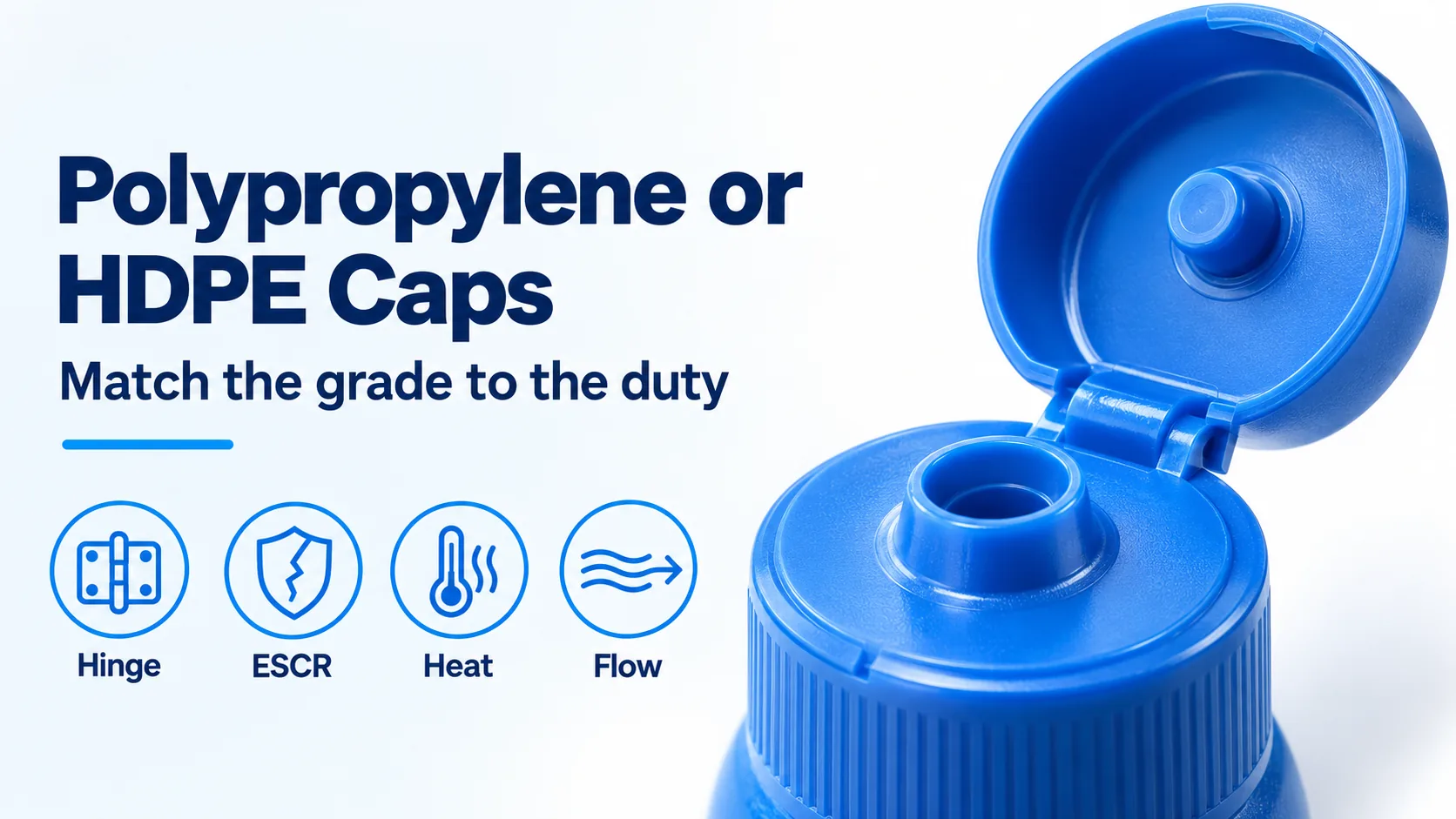
For polypropylene bottle caps versus HDPE, start with the closure’s required function and compare documented grades. Producer literature identifies PP grades for integrated hinges and an HDPE grade for beverage closures with published stress-cracking data. Those application descriptions support a shortlist, while a cap’s drawing, contents, opening requirements and thermal exposure determine its acceptance plan. This comparison distinguishes the available evidence from the checks still needed, explains why unlike melt-flow test conditions cannot rank materials directly, and shows where a resin change creates work beyond buying polymer. Keep the resin reference tied to the approved cap-and-bottle drawing pair.
| Input or item | Typical value or source | Why it matters |
|---|---|---|
| Hinge requirement | Producer’s grade-specific application description | A polymer family name does not specify acceptable opening behaviour |
| Stress-cracking requirement | Exact method, medium, endpoint and agreed acceptance value | Unlike tests cannot establish equivalent performance |
| Thermal exposure | Actual package duty and qualified grade data | Processing temperatures do not define safe use temperatures |
| Resin substitution | Controlled change record | An unchanged cap drawing does not approve a new material |
Compare grades against closure failure modes
Compare the fetched application evidence rather than treating every PP grade or every HDPE grade as equivalent. The PP descriptions below come from the caps-and-closures table in Borealis’ rigid consumer products brochure, printed pages 18–19. The HDPE description comes from its separate product data sheet.
| Material candidate | Fetched producer evidence | Dominant Failure Mode & Prevention |
|---|---|---|
| PP homopolymer | HE125MO listed for hinge and wide-mouth closure applications | Hinge damage: agree an opening test on the molded design |
| PP random copolymer | RE420MO and RF777MO listed for integrated hinges | Unacceptable whitening or hinge function: inspect after the agreed opening sequence |
| PP heterophasic copolymer | BH381MO described for hot-fill applications | Heat-related loss of package function: qualify the assembled package under its actual duty |
| HDPE | MB5568 intended for beverage caps and closures, with stress-cracking data | Cracking under the relevant exposure: evaluate the grade and assembled closure against the agreed test |
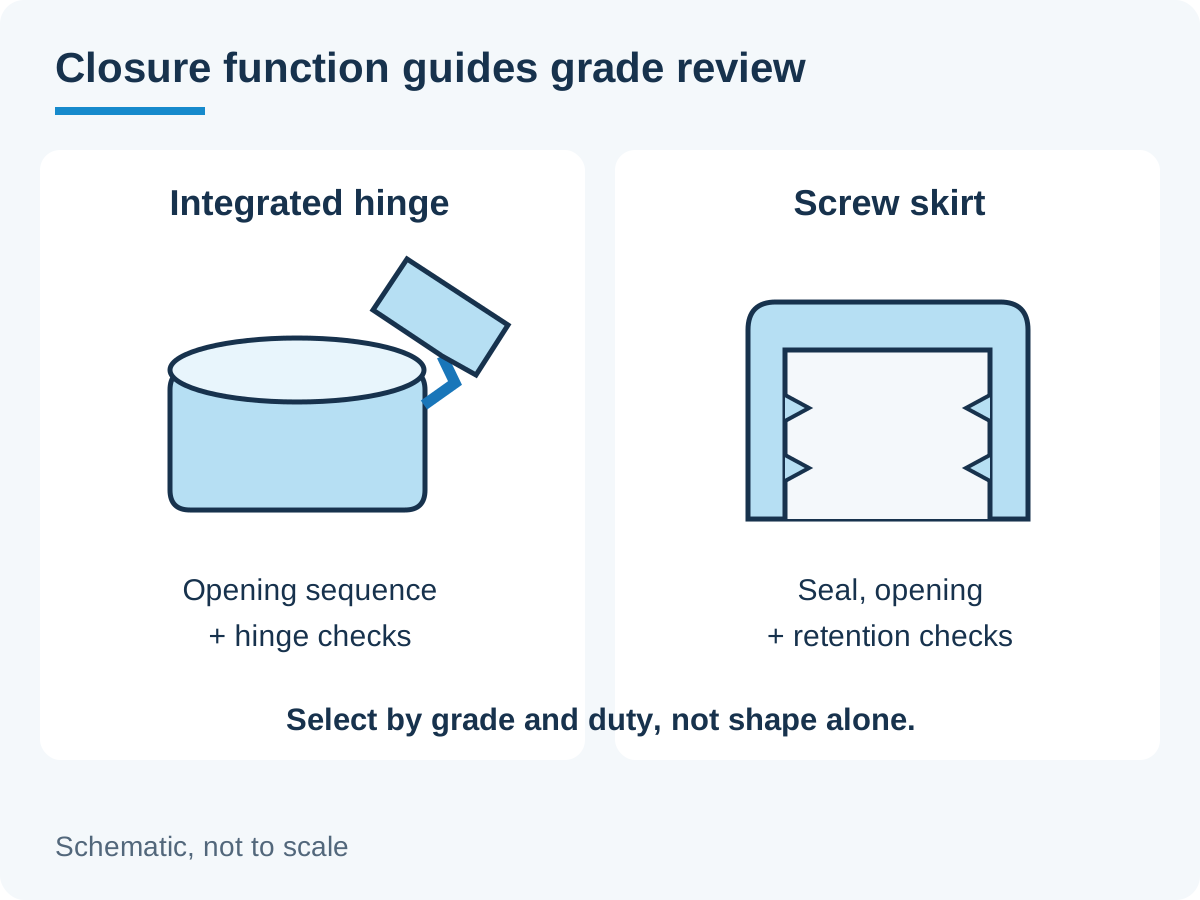
The failure-mode checks are proposed qualification tasks, not producer guarantees. “Copolymer PP” alone leaves a useful distinction unresolved: the random and heterophasic candidates above have different stated application roles. Specify the actual candidate before designing the trial.
For a flip-top, define the opening sequence and acceptance criteria. For a screw closure, define the relevant sealing, opening and retention checks. Include the contents and package handling conditions in either plan. The table does not establish a winner for a package whose requirements remain unspecified.
Read ESCR as a test result, not shelf life
Use the complete test identity when evaluating environmental stress crack resistance. The MB5568 product data sheet, edition December 20, 2017, lists typical ESCR of 750 hours under ASTM D1693-B, with Igepal 10% and F50. Its ESCR row does not state a temperature. The sheet explicitly excludes its typical data from specification work.
Acceptance rule: if a purchasing requirement calls for a guaranteed minimum of 750 hours under that same test, a typical result of 750 hours cannot qualify the grade by itself. Obtain evidence against the agreed minimum and full method conditions. The identical number does not convert a typical value into an acceptance guarantee.
That result is not a shelf-life prediction for a filled bottle or evidence for an unspecified PP grade. Record the method, exposure medium, endpoint and acceptance basis before comparing another report. A blank property cell leaves the comparison unresolved.
Check melt-flow temperatures before ranking flow
Compare melt-flow results only with their test conditions visible. The brochure’s closure table specifies PP at 230°C and PE at 190°C, both under a 2.16 kg load.
The explicit temperature check is:
ΔT_test = T_PP,test − T_PE,test
Worked example — published test conditions: ΔT_test = 230°C − 190°C = 40°C, at the same listed 2.16 kg load. This difference identifies unmatched test temperatures; it is not a cap’s heat-resistance margin.
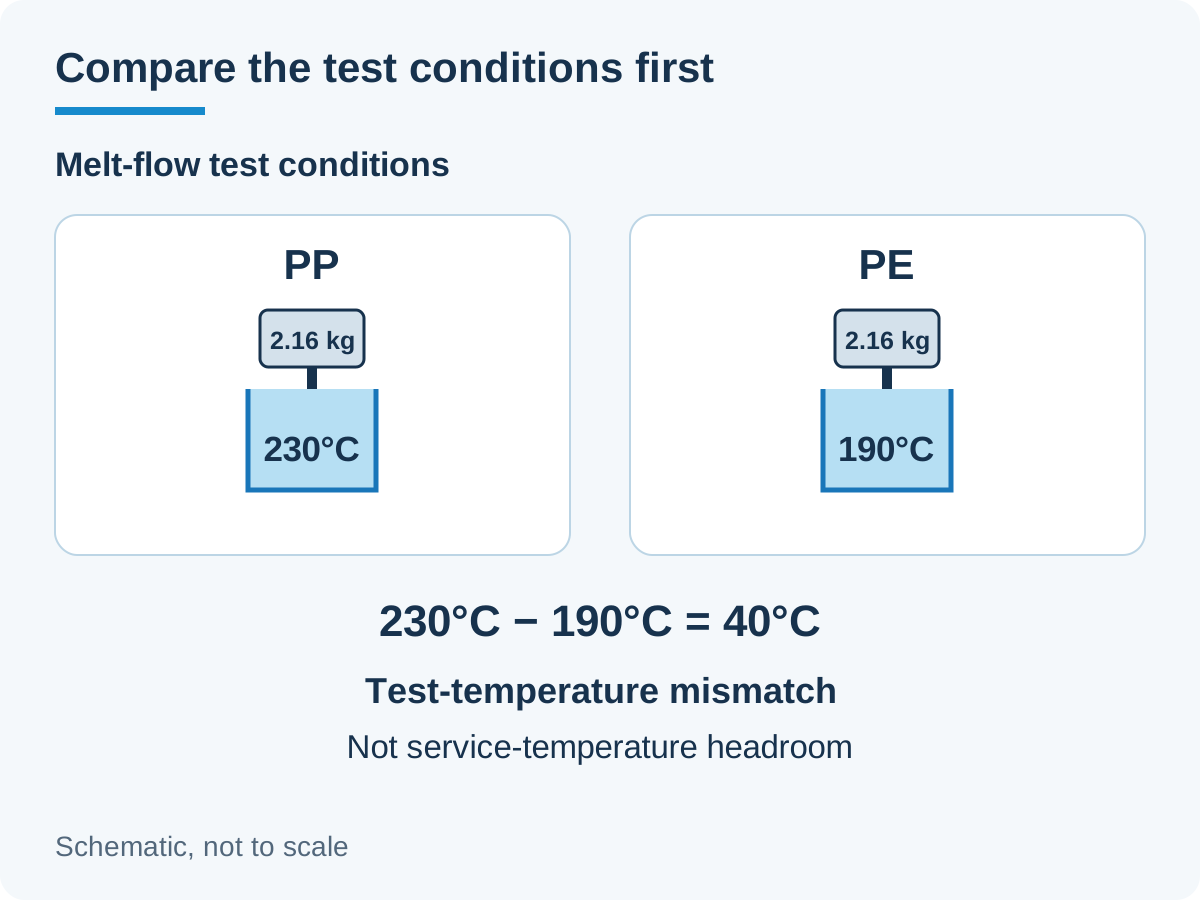
If the test-temperature difference is nonzero, do not rank the resins by their melt-flow numbers alone. Matching the temperature is only one comparison check; retain the full test method and grade identity. Use the material supplier’s processing assessment and a defined molding trial to evaluate the proposed tool.
Likewise, an application label such as hot-fill does not supply a numerical package-use temperature. Define the actual exposure and obtain suitable evidence before releasing that duty. The fetched application table supplies no universal PP-versus-HDPE temperature limit.
Include the hidden cost of a resin change
Count requalification and transition losses when considering a substitution. A material change should trigger a documented review of the existing package approval, even when the nominal cap dimensions stay the same. Carry the proposed grade into the bottle neck finish compatibility change record.
| Hidden cost input | Record before comparing candidates | Decision use |
|---|---|---|
| Transition scrap | Consumed material and disposition of trial caps | Include material that never becomes accepted product |
| Tooling review | Dimensions reviewed, changes needed and associated work | Identify work caused by the proposed substitution |
| Qualification | Required package checks, samples and responsible parties | Keep uncompleted approval work visible |
| Production interruption | Changeover and adjustment time within a defined window | Compare time to accepted output |
| Retained references | Resin lots, colour references and drawing pair | Preserve the evidence needed to investigate later variation |
Use the same boundary for both candidates: total consumed material divided by accepted caps gives material consumption per accepted cap. Record review, tooling and qualification work separately rather than hiding it in an assumed resin saving. If the molding route also changes, apply the common output boundary in the compression-versus-injection guide.
Release the grade with the package evidence
Release a specified grade against an approved package requirement. Retain the resin reference, drawing pair, sample identity, methods, results and approval responsibility together. Assign missing heat, exposure or hinge requirements before a trial so that a visually acceptable cap does not become the only selection criterion.
Use the plastic closure machinery guide to connect that material decision with tooling and process scope. A grade shortlist becomes a production choice only when the required evidence supports the intended closure and bottle combination.
Methods and sources
Based on Borealis’ rigid-packaging brochure, file dated August 2022, and its MB5568 data sheet, edition December 2017; both accessed October 19, 2026. The calculation subtracts published test temperatures. Qualification and cost records are editorial recommendations. Confirm current supplier documents for purchasing; these sources do not establish a package’s approved service temperature or hinge life.
Updated October 2026.