A machine comparison can favour the wrong process when the two offers describe different caps. Compare compression and injection molding against one controlled closure drawing, resin specification and acceptance plan.
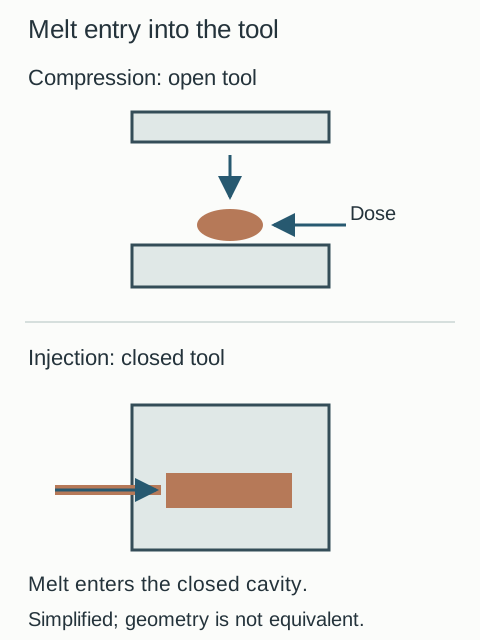
The melt enters the tool differently
In continuous compression molding, the machine meters a dose of molten polymer into an open mold; the tool closes to form the cap. In injection molding, the machine injects melt into a closed mold through the delivery system. SACMI describes those working principles in its comparison for flat-top closures.
That document is a supplier’s explanation, with an explicit focus on high-volume, relatively small closures. Its process description is useful; its productivity and energy advantages should remain attributed claims unless you have comparable project data. This article does not turn them into a universal percentage saving or a ranking of equipment suppliers.
Keep the same cap at both sides of the comparison
Send both process suppliers the same drawing revision and performance requirements. Specify the cap’s mating bottle, resin requirements and any band, liner or assembly operations. Ask each supplier to state deviations rather than quietly substituting a simpler cap to obtain a better machine rating.
| Comparison input | Continuous compression question | Injection question |
|---|---|---|
| Geometry and resin | Can the proposed tool and dosing process form this cap? | Can the proposed tool and melt-delivery system form this cap? |
| Tooling | What mold sets and wear parts are included? | What mold and melt-delivery components are included? |
| Finished quality | Which dimensions and functions were accepted? | Were the same dimensions and functions accepted? |
| Downstream work | What slitting, folding, lining or assembly remains? | What equivalent work remains after ejection? |
| Changeover | What changes with resin, colour or cap variant? | Which equivalent changes are included in the stated time? |
| Inspection and rejection | How are accepted caps counted? | Is the same good-cap boundary used? |
If a design includes features outside the demonstrated tooling scope, keep that combination unresolved. A process family name cannot establish that the supplier has made the particular geometry you need. Ask for a relevant sample, drawing review or trial proposal.
Compare the whole accepted output
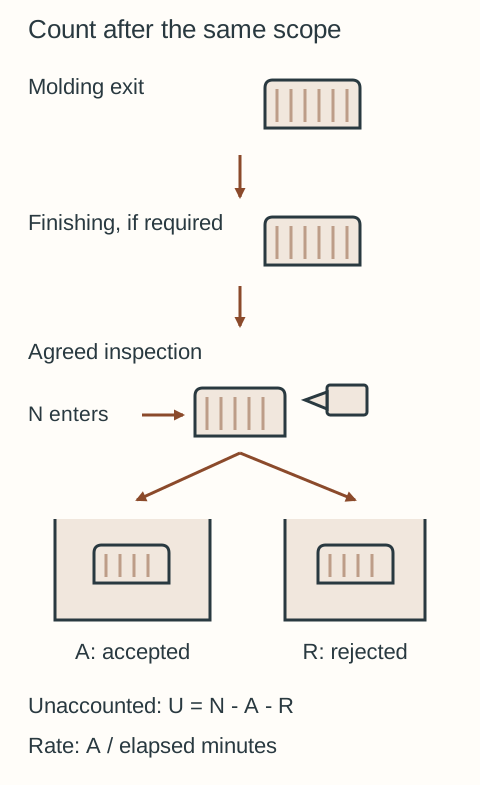
Define the measurement boundary before evaluating energy or productivity claims. Ask whether a quoted figure includes auxiliary equipment, cooling, material handling, startup scrap and downstream operations. Both suppliers should report output at the same stage, after the same agreed inspection rules.
Request the duration and conditions of the demonstration, including resin grade, colour, drawing revision and rejected output. A molding press can deliver parts before the closure is ready for shipment. Counting at press exit in one offer and after inspection in the other creates a misleading comparison.
Blank output comparison
Use one timed observation window at the agreed inspection boundary. Count every cap entering that boundary once. Keep caps still awaiting a decision in U until reconciled; do not relabel them accepted. The elapsed time includes the interruptions inside the chosen window. Record start and end times and use the same convention for both trials.
| Input or result | Unit / calculation | Compression trial | Injection trial |
|---|---|---|---|
| Cap drawing / resin / run ID | References | ____ | ____ |
| Finishing and inspection scope | Agreed operations | ____ | ____ |
| Observation start / end | Date and time | ____ / ____ | ____ / ____ |
| N: entered inspection boundary | caps | ____ | ____ |
| A: accepted at outlet | caps | ____ | ____ |
| R: physically rejected | caps | ____ | ____ |
| t: elapsed window | minutes, greater than zero | ____ | ____ |
| U: unaccounted or awaiting disposition | caps; N - A - R | ____ | ____ |
| Accepted output rate | caps/min; A / t | ____ | ____ |
| Reconciliation / release decision | Resolve U; apply agreed acceptance rule | ____ | ____ |
These equations define this worksheet, not a machine rating. Leave the rate blank if t is zero or unknown. Resolve a negative U as a counting error; a nonzero U requires investigation before treating the counts as complete. Download the blank output comparison TSV, or copy the table into your own record.
Put maintenance and changeover into the trial brief
Ask which maintenance tasks can be demonstrated, which require stopping production and which parts are held as spares. Keep the task description concrete. ‘Easy maintenance’ gives little information without an access procedure, component list and staffing assumption.
For colour or format changes, define the beginning and end: last accepted cap of the old job and first accepted cap of the new one, with the cleaning, tool changes and rejected transition material identified. This is a suggested evaluation boundary, not a claim that either technology reaches a particular time.
Make the decision conditional on evidence
Use the table below as the final comparison sheet. Complete one row per proposed line rather than merging all machines of one technology into a single result.
| Evidence row | Record before choosing |
|---|---|
| Proposed cap | Drawing revision, bottle finish and resin grade |
| Complete scope | Included press, tooling, auxiliaries and downstream operations |
| Trial basis | Sample provenance, duration and acceptance methods |
| Observed accepted output | Values supplied by the trial owner, with units and measurement boundary |
| Open issues | Unproven geometry, excluded equipment or missing quality evidence |
| Release condition | What must be demonstrated before the selection is final? |
A closure producer should also resolve bottle-finish and drawing control before releasing tooling. The inspection acceptance guide helps define the good-cap boundary used in the production comparison.
For the injection-tool drawing review, use the plastic closure injection molding design guide to resolve thread release, draft and wall geometry before comparing accepted output.
Methods and sources
Based on SACMI’s public process comparison, compression-molding description and post-processing brochure, accessed October 2026, with local library research used to identify related equipment material. No plant measurements or paired process trials were available. The comparison sheet is editorial guidance. Return to plastic closure machinery.